
Restore Damaged Teeth.
Replace What's Missing.
Smile with Confidence.
A damaged, weakened, or missing tooth can affect more than your smile — it can make chewing uncomfortable and place pressure on surrounding teeth. At Dr. KP's Confidenz Advanced Dental Care in Hyderabad, we provide customized dental crowns, caps, and bridges to restore natural appearance, function, and oral health.
What Are Dental Crowns, Caps & Bridges?
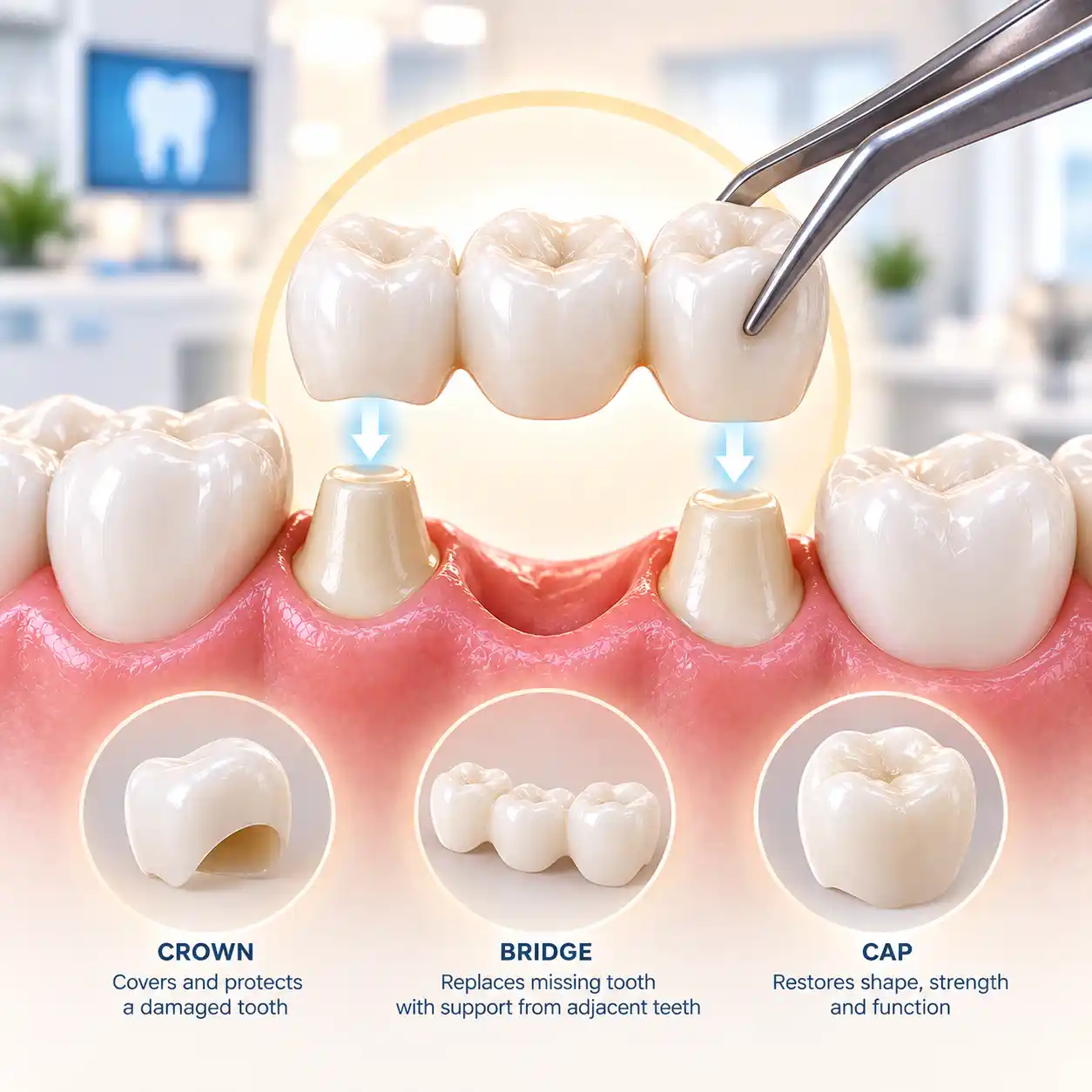
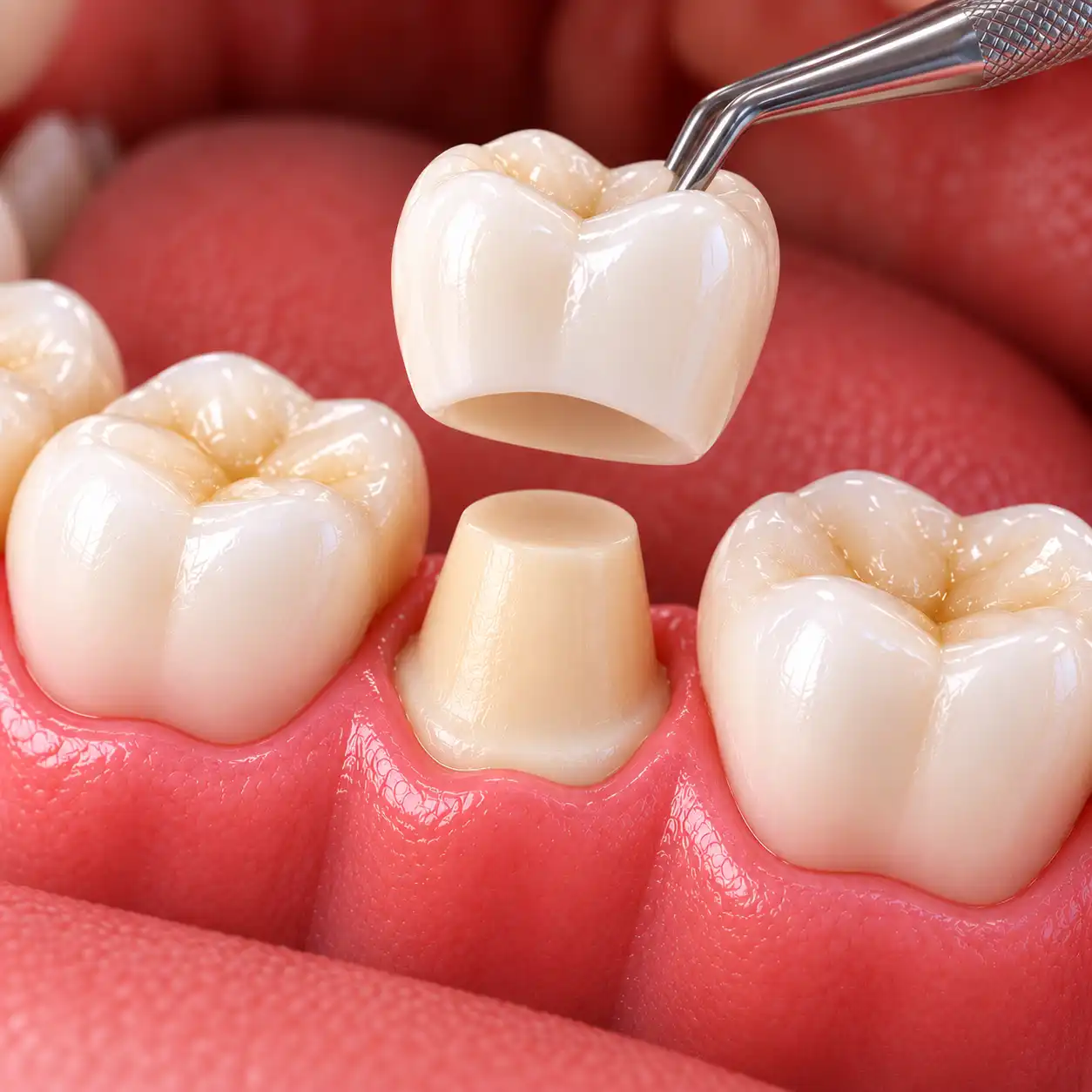
A dental crown, commonly called a dental cap, is a custom-made restoration that covers a damaged or weakened tooth — restoring its strength, shape, function, appearance, and bite.
A dental bridge replaces one or more missing teeth using artificial teeth supported by adjacent teeth or dental implants, helping restore chewing function, speech, and smile appearance.
In everyday dental language, "cap" is simply another word for a crown — it doesn't refer to a separate treatment. The most appropriate restoration depends on your individual oral health and clinical condition.
- Restores tooth strength and function
- Replaces one or more missing teeth
- Preserves as much healthy tooth structure as possible
- Designed to blend naturally with your smile
Why Do Teeth Need Crowns or Bridges?
Teeth can become damaged or lost for several reasons — understanding the cause helps determine the right restoration.
Extensive Tooth Decay
A cavity that has progressed extensively may weaken the tooth beyond what a regular filling can reliably restore — a crown may protect the remaining structure.
After Root Canal Treatment
Heavily restored back teeth may need additional protection after RCT. A crown can help restore strength when clinically indicated.
Cracked or Fractured Teeth
A cracked or damaged tooth may need a crown to protect the remaining structure. The right treatment depends on the location and extent of the fracture.
Missing Teeth
When a tooth is missing, neighbouring teeth can gradually shift. A dental bridge may be one option for replacing it and restoring function.
Do You Need a Crown or a Bridge?
A crown and a bridge serve different purposes. A clinical examination is necessary before determining which restoration is suitable.
A crown may restore structural stability.
Additional protection may be recommended.
Beyond what a regular filling can reliably restore.
A crown may protect against further damage.
A bridge may be a suitable fixed replacement.
Neighbouring teeth can provide bridge support.
A bridge offers a non-removable replacement.
A bridge may be considered as an alternative.
When a Crown May Be Recommended
We do not recommend a crown simply because a tooth looks damaged. First, we determine why the tooth requires restoration and whether the underlying tooth can be preserved.
A crown may be recommended when:
A clinical examination is necessary before determining which restoration is suitable.
Diagnosis Comes Before Restoration
We first determine why the tooth requires restoration and whether the underlying tooth can be preserved.
Consultation
We discuss your concerns, dental history, previous treatments, and expectations.
Comprehensive Examination
The affected tooth and surrounding teeth are evaluated for decay, cracks, gum health, and bite.
Dental X-Ray When Required
Radiographic examination assesses tooth roots, surrounding bone, and previous treatments.
Personalized Treatment Plan
We explain the recommended restoration, alternatives, timeline, and estimated cost before proceeding.
How Dental Crown Treatment Is Performed
A carefully planned process, from preparation to final placement.
Local Anaesthesia
The treatment area is comfortably numbed to make the procedure as comfortable as possible.
Tooth Preparation
A controlled amount of tooth structure is prepared, preserving as much healthy structure as clinically possible.
Digital Impressions
An impression or digital scan captures the shape and dimensions needed for the final restoration.
Shade & Aesthetic Planning
For visible teeth, colour, shape, and proportions are considered for a natural-looking result.
Temporary Restoration
A temporary crown may protect the prepared tooth while the permanent restoration is fabricated.
Final Crown Placement
Fit, bite, contacts, and appearance are evaluated, adjusted, and the crown is permanently cemented.
How Dental Bridge Treatment Is Performed
A fixed restoration designed to replace one or more missing teeth.
Comprehensive Assessment
The missing tooth area and supporting teeth are examined to determine whether a conventional bridge is appropriate.
Treatment Planning
Supporting teeth, gum health, bite, and aesthetic requirements are evaluated. Implant-supported options may also be discussed.
Preparing the Supporting Teeth
For a conventional bridge, the supporting teeth are carefully prepared to accommodate the restoration.
Impression or Digital Scan
Precise impressions or digital scans are taken to design the bridge.
Temporary Bridge
A temporary restoration protects the prepared teeth and maintains function while the permanent bridge is fabricated.
Final Bridge Placement
Fit, bite, appearance, and comfort are checked before the bridge is securely fixed in place.
Crown or Bridge: Which Is Better?
A crown is designed primarily to restore a damaged or weakened tooth. A bridge is designed primarily to replace one or more missing teeth. We evaluate your oral health and explain the appropriate options rather than recommending the same solution for every patient.
A bridge may be considered when:
Other options such as dental implants or partial dentures may also be considered depending on your situation.
After-Care for Dental Crowns & Bridges
A crown or bridge does not make surrounding teeth immune to decay or gum disease — good oral hygiene remains essential. With proper care, restorations can remain functional for many years.
What to Do
- Brush twice daily with fluoride toothpaste
- Clean between your teeth every day
- Use floss threaders, super floss, or interdental brushes under bridges
- Attend regular dental examinations and cleanings
- Contact your dentist if the restoration feels loose or damaged
What to Avoid
- Biting hard objects such as pens or fingernails
- Using your teeth to open packages
- Excessive force on a newly placed restoration
- Ignoring persistent discomfort
- Delaying a review if a crown or bridge becomes loose
Benefits of Dental Crowns & Bridges
Restorations Planned Around Your Oral Health
A successful crown or bridge needs to work comfortably with your bite, fit properly, support healthy surrounding tissues, and meet your functional and aesthetic requirements. At Dr. KP's Confidenz Advanced Dental Care, every restoration begins with comprehensive diagnosis and personalized planning.

Why Patients Trust Our Restorative Care
Years of Restorative Experience
Dr. Krishna Priya Chukkapalli brings more than 10 years of clinical experience in comprehensive dental care and personalized treatment planning.
Careful Clinical Assessment
Crowns and bridges require careful assessment of tooth structure, gum health, bite, and aesthetics — planned according to established restorative principles.
A Trusted Name in Restorative Care
Trusted by hundreds of patients, with 256+ verified Google Reviews reflecting patient experiences with our dental care and service.
Honest, Transparent Communication
We explain the diagnosis, treatment options, expected benefits, limitations, and estimated costs clearly before treatment begins.
Frequently Asked Questions
The tooth may be numbed with local anaesthesia during preparation, making the procedure comfortable for most patients. Mild sensitivity or gum tenderness may occur temporarily after treatment.
Yes. "Dental cap" is a commonly used term for a dental crown. Both generally refer to a restoration that covers and protects a prepared tooth.
A crown may be recommended when a root canal-treated tooth has significant structural loss and requires additional protection. The decision depends on the tooth, its location, remaining structure, and functional demands.
Yes. A conventional bridge can replace a single missing tooth when the adjacent supporting teeth are suitable. An implant-supported restoration may also be an option depending on the clinical situation.
Cleaning under a bridge is important because plaque and food can accumulate beneath it. Floss threaders, specialised floss, interdental brushes, or water flossers may be recommended depending on the bridge design.
Do not ignore it or attempt to fix it yourself. Contact your dentist for an assessment — a loose restoration can expose the underlying tooth to further damage or decay.
Medical Disclaimer: The information provided on this page is intended for educational purposes only and should not replace a professional dental consultation or clinical examination. Treatment recommendations vary based on each patient's oral and medical condition.

Welcome to WordPress. This is your first post. Edit or delete it, then start writing!

Welcome to WordPress. This is your first post. Edit or delete it, then start writing!
Welcome to WordPress. This is your first post. Edit or delete it, then start writing!